

What Does Success Mean to You? [Ep. #1]
1. What Does Success Mean to You?
Safe to Succeed
Read the transcript Here
Our AI tool has created a transcript in case you prefer to read. I always take a quick glance for obvious errors, but if there are any imperfections please just enjoy the giggle, or listen along. Thank you!
Episode Transcript
When I was 11, I passed my 11-plus and went to a girls' grammar school. And for the first time in my young life, I was exposed to different friendship groups outside our small and rural, close-knit community, and outside the religious organisation my mother was a part of. And when I was at this school, I became good friends with a girl called Nina, and I can't remember what her dad did for a living, but her mum was a counsellor, and that fascinated me. And I was really excited when I got invited to their house for a sleepover, because Nina was just the best company. She was so fun.
So I got dropped off, and it was at this big, beautiful country farmhouse with, like, a gravel drive. And when you went in the kitchen, it had a big fireplace and one of those kitchen tables that people actually sit around, because they were at ease in this family. And it was just gorgeous. And to this day, one of my clearest memories of that weekend is my dad in the car saying, "What's her mum do?" And me saying, "Oh, she's a counsellor." And him saying, in return, without skipping a beat, "It must be nice to get paid so much money to sit on your ass and listen to people whinge."
Now, I don't come from a family where people sit down and talk about things like ambition or success or finances and financial literacy. We just didn't have that knowledge in our family, and I don't know if other families do it that formally. But what I can tell you is that before I'd even finished my first year of secondary school, I had learned in an instant that if my version of success or ambition, or my wants and desires in life, were different to what my family had, it was dangerous. It was to be suspicious of. It was lazy if you weren't doing physical labour, the kind that gave you backache. And that actually, if you had a desire for a bigger house or a posh car and a drive, it somehow made you less worthy. It made you less of a good person.
Before I go any further, I want to say I'm not telling you that to have a go at my dad. I'll come back to why what he said made complete sense in the life he had, but it does mean that when I was 11, in my first year of secondary school, I already had this definition of success and ambition and finance instilled in me that said one version is good and the other is bad. And I am willing to bet that many of you do, because if I remember that so clearly 31 years later, you can't tell me that wasn't an important conversation, whether it was just flippant, off the tip of his tongue, or not.
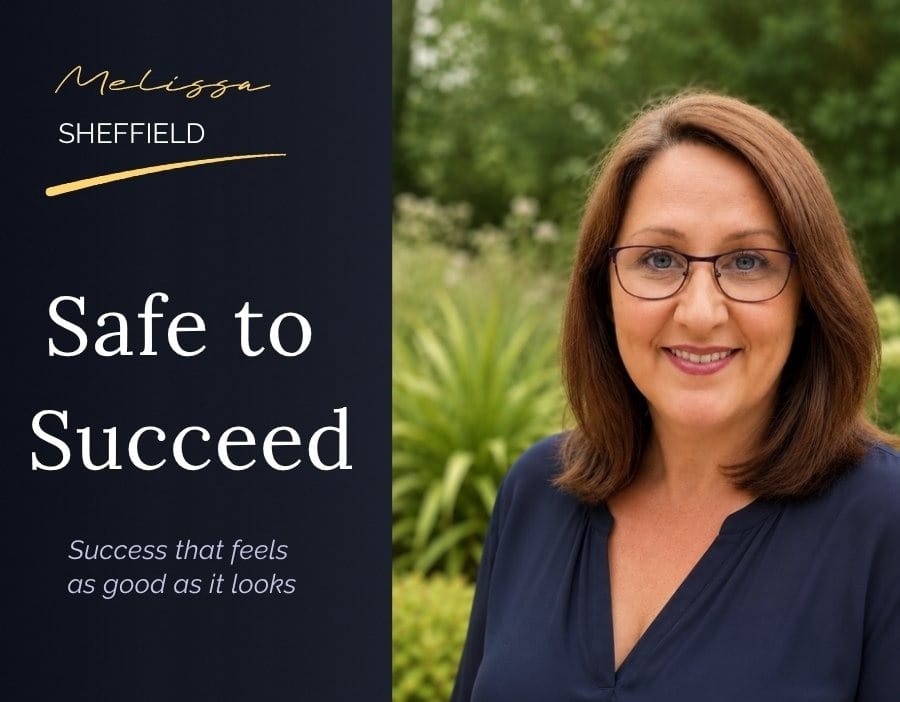
So welcome to Safe to Succeed. I'm Mel. I'm a clinical hypnotherapist and an NLP practitioner, and I am building a business working with women who have started building businesses that look successful from the outside, but really don't feel good on the inside. And I promise you, it is far more common than anybody wants to admit.
So today I want to kick off the first proper podcast episode by talking about the definition of success itself, because I think we spend an enormous amount of energy trying to get better at achieving success, but very rarely do we actually ask whose idea of success we're chasing. And that's a bit like chasing a dream, because if it's not something you really want, if it's not real to you, you're just going to keep chasing the next and the next thing.
So let's start with my version of success. Now I'm actually on version three, spoiler alert, but let's go back to my dad in the car. My dad was a farm labourer, and he worked hard for his family. I would not have anybody say otherwise. My mum was a cleaner, part time, and money in our house was "tight," is how they put it. And the only way people in our family made money was to work physically hard for many hours, and that's just how you made ends meet. That was what was expected. Both my grandads were farmers. It was a rural community, and there is nothing wrong with that, but it was very limited in terms of what people thought success was, because growing up like that means success is specific, and to be honest, quite modest by the life I live now.
Because success was making sure the bills were paid every month. It was having a rented house that came with my dad's job, so that it was secure, no landlord was going to kick you out. It was a wage that came in every single month so you could budget for one week away in a caravan in the summer holidays, even though it took all year to save for. And there were rules that came with that.
And the main one was get a useful job, because you need that stability. So I remember being, I want to say about nine, and I was putting curlers in my Nana's hair, playing hairdresser, as many of us did. And I remember her saying, "You should be a hairdresser or a nurse." And that felt weird to me as a kid, because I was playing hairdresser, the hairdresser comment made sense, but I was like, "Why, Nan?" And she said to me, and I'll never forget it, "Because it's useful, and you need to be useful. When you've got a useful job, you'll always have a job, and you'll always be okay." And that's pretty much word for word how it was put. And that came, let me be clear, from a place of deep love. This was not a woman who was saying, "You're not good enough to have a career." This was a woman saying, "I want to know you're always going to be okay, and if you have a job where you can always look after yourself, you will be."
And I remember, as I got older, I went back to uni as a mature student, and in my mid-20s I had an interview for a lecturing job. It was my first lecturing job at college. I was really excited. I told my parents, who were separated at the time, and my dad was really excited and told me to go for it. And even now I remember my mum saying I was getting above my station and I was going to be disappointed.
And I don't believe that came from a place of being mean. It came from a place of her wanting to not have her daughter disappointed. And for a while I resented that limiting belief of what I was capable of, and I went on a mission to prove everything wrong, because I felt like people were trying to put rules on me based on their limitations. But what they were doing was trying to keep me safe, because every one of those beliefs was accurate, and it was sensible, and it was what made our world tick. It was what kept us fed and housed and on holiday for a week every year, even though a lot of our other friends and family didn't do that.
So the problem wasn't that my parents instilled in me, "You need a useful job and you need to work hard." It was just that I never stopped to check if that exact version of success applied to me.
So this is the first question I'd like you to think of while you listen to me ramble on. Whose voice is in your head when you think of success? Is it really yours? Is it conversations from friends, from family, from people who genuinely loved you but wanted something a little bit different, that you gave into? Because I'd put money on most people tracking that voice back to it not being theirs.
And the reason that it's not yours is because these beliefs start so young, so young. A child doesn't hear this statement about success or ambition and then weigh it up and critique it, and think about the mood and the finances and the family dynamics and all those things, and then choose whether to keep or bin this belief. They just file this away: that's a comment, my dad thinks this, my mum thinks that. And then these beliefs build over years. So the earliest things that you absorbed will have gone in without a filter at all, and quite probably stored as facts, because they will have come from people who you love and trust. And there is nothing wrong with that, especially when people are meaning well.
But it's hard to pick out a single moment. Sometimes it is a conversation with your Nana or your dad in the car, and you remember it years later. But a lot of conversations around money and careers and success and ambition will happen just ad hoc, numerous conversations across the kitchen table that you can't quite put a finger on, but it's stuff you absorbed.
And then school comes along, and that adds its own layer, because for a lot of us, we want to be good. We want to do it right. We don't want to make a fuss. We don't want to stand out to our teachers or to our peers. And then we go on to work, and work adds another layer around what success is and what it should be, and people's opinions on that, is ambition good or bad. And this is why so many of us still feel rather guilty for having a productive day but not having it feel like hard work, or not having it tick everything off the list, because these old conversations are still playing in our heads.
So my second version of success was adulting, because I was actually the first person in my family to go to university, and I did that after being a single parent in my teens. So it really opened up my mind enormously, and at that moment in time I really thought I'd left this old definition of success behind. That old checklist: a rented house, a stable job, a week away in a caravan. Tick, tick, tick. I honestly thought it had gone, but it hadn't. I'd swapped it in for a bigger tick list.
So work hard stopped being physically hard work and became working hard while I did sit on my ass, which, given the conversation in the car, I struggled with for a long time, because the good job also stopped meaning have a permanent job, and it started meaning I want a career path, you know, I want to know where I'm going next. That stable home stopped being a house that was rented and tied to a job, and it meant owning my own home with a mortgage, which I was really proud of, but also really stressed by, because I'd never appreciated, not growing up in a house that was owned, how much that costs, all those things landlords used to fix, gone.
And then I upgraded the caravan holiday, because I wanted to travel, and I just took the kids on package holidays. Nothing too fancy, but we did places like the Algarve and Malta, and we did kids with sun cream and ice creams and postcards home from more exciting places. And every single one of those upgrades on the checklist felt like freedom when I was doing it. And every single one of them, now I look back, kept that original checklist structure of success completely intact.
Because that structure of my success checklist I'd picked up as a kid, it was never about what was on it. It was about, there is a list of things you have to have, external things, the home, the holiday, the kids in a nice school. You had to have them until you'd ticked enough of those boxes, and then you can say you're successful.
And good news for me, it's not just me. I see this constantly in women I'm working with who have moved a really long way from where they started, and they can see that their situation's changed, but actually their version of success hasn't changed as much as they think. So maybe they get better clients who are more aligned, maybe they earn better rates, maybe these women go home to a nicer house, and they are successful by those measures, but they're also feeling dissatisfied and exhausted with how confusing it is.
And I understand how confusing it is, because you've done the things that you set out to do, you wrote down your external checklist, and you ticked everything off. And you are literally waiting for this feeling of success and contentment to come. And it's just not there. And actually it's leaning more towards frustration, and potentially resentment and anger towards your business. Because you know, you have done the things that were on your list to make you successful. You know the feeling should be there, but it isn't.
The trouble is, enough is not a number. Enough is never a number of clients. It is never a number of income. It is never a number of things you tick off a list. Those feelings are never attached to any of those items on that list. So however many you tick off, irrelevant, that is not going to make you feel good.
So if you can't actually measure your way out of it with a number of ticks on the tick list, where do you start?
Now, this is where I start talking about NLP, because the quickest way to find a belief that isn't yours is to catch it in the way you speak about things. And this is a great game to play with yourself, or to buddy up with other people, because it takes no time. It's about you noticing what you're saying and thinking already.
Now, the first thing I listen for is what we call modal operators, but don't get hung up on the terminology. It's literally the label for little words that mean: are you choosing something, or are you following a rule? So think of words like "have to," "must," "can," "cannot." So when I have a client who says, "I have to be available in the evenings," there's a rule there. And that rule is kind of like invisible handcuffs to you. You might not realise it's a rule you've written for yourself. Sometimes people do. Sometimes there's caring responsibilities, childcare, et cetera. But for a lot of people, the first answer out of your mouth is the practical one around expectations of other people, whether that's clients, friends, family. And the second answer, when I ask why and poke a little bit, most people take a pause, they have a little think. That second version is typically the actual belief that's under it. So "I have to check my emails in the morning" actually becomes "I check them before I'm even out of bed, because I'm worried I won't look committed to my clients if I don't."
Now the second thing I listen for is the word "success" itself. Now in NLP that is a nominalisation. Again, don't get hung up on it, but it's a process that's frozen into a thing. And I love this one, because it's just hiding in plain sight in the title of this episode. Nobody has ever been handed a success. There is nowhere you can go and buy a success. Success is a judgement you make every minute of every day, against a standard that either you or somebody else has decided. And it's that set standard, that rule book that people don't look at. So whenever you catch yourself saying you want to be successful, the useful move is to unfreeze success and look at "successful according to who?" and “ What do I think is successful?” What's underneath that?
And the third thing that I look for using NLP is a presupposition, and that's the belief that's kind of hidden inside the sentence rather than actually said out loud. And the most common one I've heard over the past six months from women I work with, which is why I'm starting this podcast, they keep saying, "I'm just not ambitious enough."
And the thing here is, it sounds like some kind of admission of guilt, almost, but it's carrying these assumptions. It assumes that ambition has to run on a single, linear scale, and we have to be following that. And it assumes that it goes in a single direction. It assumes there's a correct amount of ambition to have. And it assumes that you are not on that scale, in the right place, at the right time, with the right level of ambition. And I don't think women ever take it apart in that way without a little bit of prompting, should we say.
Because, to me, I have less pressure, less work hours, less of a lot of things I didn't like about corporate life, less fancy titles, less emails, less stress. And that comes with good and bad. But the reality is, I'm probably more ambitious now. I'm just intentionally ambitious. I'm choosing success in the way success aligns with me and the life I want. And I think this is a conversation we need to have as women, because saying "I'm choosing a different version of success, my version of success," is really different to saying, "I'm not ambitious enough, I'm not successful enough."
And no, I'm not asking you to get up in the morning every day and do affirmations in the mirror. But I am asking you to think, if you are saying you are not ambitious enough, why? And why is it a bad thing? Is it you're not ambitious, or is it you're not hungry for this trajectory that you are on and would rather like to get off?
So what happened for me, when I found hypnotherapy and I kind of burnt my life to the ground, so to speak, I decided I was going to picture a normal Tuesday. I didn't want to look at a special day, like a holiday or a romantic night out or a big launch day in business, any of those special moments. I just wanted to think: what does an ordinary Tuesday look like in a life I want?
And here's the key, it's got to be clear enough for you to picture it in your head. I don't want any vague here. So I really had to sit down and almost write it like it was a diary entry at the end of the day, this is what I did. So I want you to have a think about this. If this was a typical Tuesday, it was just another day in another week, what time would you get up? Would you reach for your phone straight away and check those emails? Would you do something else? Who's in the house? What mood is the house in? When it's 10 o'clock, what are you doing? What's happening at three in the afternoon? What does the evening look like?
And the reason I say be specific with yourself is because vague is how we dodge this one. And when we say we want freedom, it's not actually an answer. Freedom looks different to everybody.
For me, I'm actually recording this on a Tuesday. My day was a typical Tuesday. I got up and had a cup of coffee with Ewen before he went off to work, that's my husband. And then I sat down and did an hour of work. And then I got to take Ollie, the office manager, out to a local dog field, so they do secure hire fields. And we had a wander around and we came back and got lunch. This afternoon I actually saw my daughter. And then I did a couple of hours of work, including this podcast. And then the laptop goes off.
So it's not just, "I'm working part time." It's, there's a freedom of flexibility around, I'll do an hour in the morning because that's when I like to tick something off my list and feel accomplished, and then I take Ollie out, and you know, I'm not sitting there having to concentrate for too long. That, to me, is freedom: to live in a beautiful part of the UK, and to have that flexibility around seeing my husband, seeing my daughter, enjoying my dog. And yours will be different, and what I need you to know is that is okay.
That is how it is meant to be, and you shouldn't need permission to know that's okay. But if you do need permission, please take this as it. Your version of success, it's okay to want that. Because where I am now, with my version three success, life and intentional ambition, I was sick, to be honest, of watching other people do it.
Because by the time I'd moved into sort of senior operations roles and executive coaching, I ended up working with founders and directors and CEOs, which meant I got to see up close and personal, so to speak, what people actually do when they've got genuine autonomy over their lives.
So one founder I supported, I was his coach and head of ops. We got his app, from a smartphone and VR headset, registered as a medical device, got onto a health tech accelerator, which came with funding, and you know, government funding is not easy to get in health technology. And it was serious work by anybody's standards, whoever you looked at. It was the kind of thing where, if I was back at 11 in the car with my dad, he would have said, "Wow, they're messing about, sitting on their asses." And I would have said, "Wow, that's important and impressive."
And despite him having all these responsibilities, he had a teenager with additional needs, and he was at the school gates at three o'clock every single day, because he built a business that supported the life he wanted. Nobody gave him permission, and there wasn't a policy, there wasn't a reward, but to him, that school run, to pick his son up, to know how his day was before we saw anybody else, that was his non-negotiable. And his world was built around that version of success, because to him, he was dad first, founder second.
And this is where intentional ambition comes from, because up until that point, I'd understood success as, you get rewarded when you've done enough. If I wanted that promotion at the college, I'd plan more classes at home, I'd show off a little bit of my prep work, I'd make sure my paperwork was good. Working with him was different. I was watching him design success. I was watching him set boundaries so naturally, I just couldn't believe it. And I was realising that the impact of the work, and the shape of the day, it was decided by him, on purpose. He was not choosing to run himself ragged and give himself and his family what was left. He was building his life intentionally.
So when I retrained as a hypnotherapist, I started working with women experiencing burnout, and that was really rewarding work. But the common thread I noticed throughout almost everyone, over six months of doing it full time, the common thread was always they were doing things out of alignment. We know that causes burnout, but the underlying reason they did it was typically other people's expectations. And when you ask them where they really wanted to go to, nobody really knew, because it felt like this big, scary pivot.
So now I am on a mission to help as many wonderful women as I possibly can figure out what their version of success is, so that your business supports the life you actually want to love.
So before I let you go, the reason I want you looking at that definition, instead of just having a checklist of success, the reason I want you to think about your version of success and what it is, is, as women, we are trained from a young age to keep the peace, keep comfortable relationships, keep doing all the work to prove you're capable. We are literally programmed to push ourselves into burnout, to push ourselves into a nine to five where we meet other people's expectations. We're pushed to do the best work in the room from behind the scenes, while somebody else is visible for it.
And the thing is, every one of those careers and ambitions started as some kind of strategy that works. And if it is still working for you, then that is a good thing. But for many women, it isn't. It isn't giving them the flexibility for their families. It hasn't given them the alignment with their morals and their values they want. And it isn't leaving them feeling successful at all.
So now, something I want to be clear about is the limitation of everything I've said today. I've given you some things to think about, I hope, but it's just the conscious work. And conscious work is not what I do best as a hypnotherapist. I work with your subconscious.
So I have recorded a free hypnosis track, completely free, to go with this episode, which takes this material and helps you visualise your version of success. So I'm going to put the link down below. It's on my website at melissachefield.com, and you can download it completely for free. It's only 20 minutes, and it will help you get clear on what you really want.
So to wind up today, the question in the title: what does success actually mean to you? Not what it should, not what it could. What does it really look like right here, right now, today? Because you cannot build a life that you've never defined. You'll just keep chasing things and waiting to feel different about things, and that feeling is not going to turn up, because if it was going to show up, that satisfaction, that contentment, that feeling of success, would be with you already.
So if something's actually got you thinking along, as you've been listening to me, if you're keen to find your own definition, then please remember, this is your permission to do that. You don't need it, but if you want it, here it is. And keep changing that version as often as you want to, for the rest of your life, because this is your life. It is your business, and that business should be supporting the life you want to live.
That is my version of success.
Take care, and I'll speak to you soon.


Quoted This Week

Topics Included this week
Where beliefs about success, ambition and money actually come from
Mel's own three versions of success, from the checklist she grew up with to the "adulting" checklist to the intentional version she lives by now
Three NLP tools for catching a belief that isn't yours
Why "I'm not ambitious enough" is worth unpacking, and what intentional ambition looks like instead
A practical exercise for clarity on the life you actually want to live
YOU MIGHT ALSO LIKE
Large Call to Action Headline

M.S.
About Mel
I'm a clinical hypnotherapist and NLP Practitioner who specialises in subconscious shifts, identity moves, and success on your terms. I help women building successful businesses create subconscious safety around their own version of success, so they can build a business that supports the life they actually want to live.



Subconscious Safety and Success Tips in your Inbox!

Free Signup
Melissa Sheffield | Hypnotherapy
We use cookies to run this site and, with your permission, to understand how it's used. Essential cookies are always on. Read our Cookie Policy.