

Why More Money Is Not Enough [Ep. #2]
2. Why More Money Is Not Enough
Safe to Succeed
Read the transcript Here
Our AI tool has created a transcript in case you prefer to read. I always take a quick glance for obvious errors, but if there are any imperfections please just enjoy the giggle, or listen along. Thank you!
Episode Transcript
And I know this feeling. It's January, you're doing a vision board, planning out your year, and you write down a specific number that you are going to make to prove you've got a successful business. It's somewhere on the desk, maybe shoved in a drawer. And eventually you hit that number. And you sit there waiting to feel successful, except you don't. Or maybe you did for five minutes, but when that initial excitement fades, that feeling that's left is not a successful feeling. And the strange thing is, you cannot say out loud that it feels empty, because the minute you do, you sound ungrateful.
And I know you are genuinely not ungrateful. You are genuinely pleased. You just don't feel what you thought you would feel when you hit such a big milestone. So then you do what many, many people do, and you say, okay, if this doesn't feel successful, I must have got the number wrong. So you set a bigger number, whether that is more money or whether that is more clients, and decide that's why it doesn't feel like enough. I was just playing it down. When I hit a bigger number, better revenue, more clients, then I'll feel successful. And I understand how frustrating that is, because you have just got yourself in a loop. It is Groundhog Day, because you've already done the work and the money is real and the business is real and the client testimonials are real. And the feeling of success and happiness and contentment, and all those feelings that you built this whole business for, it's just not there.
And today I want to talk to you about why money does this to a belief, and why what you believe decides what you actually notice. What a bit of research says (I promise I won't go into it like it's school) and why this is actually subconscious work, not think harder, do more hustle work.
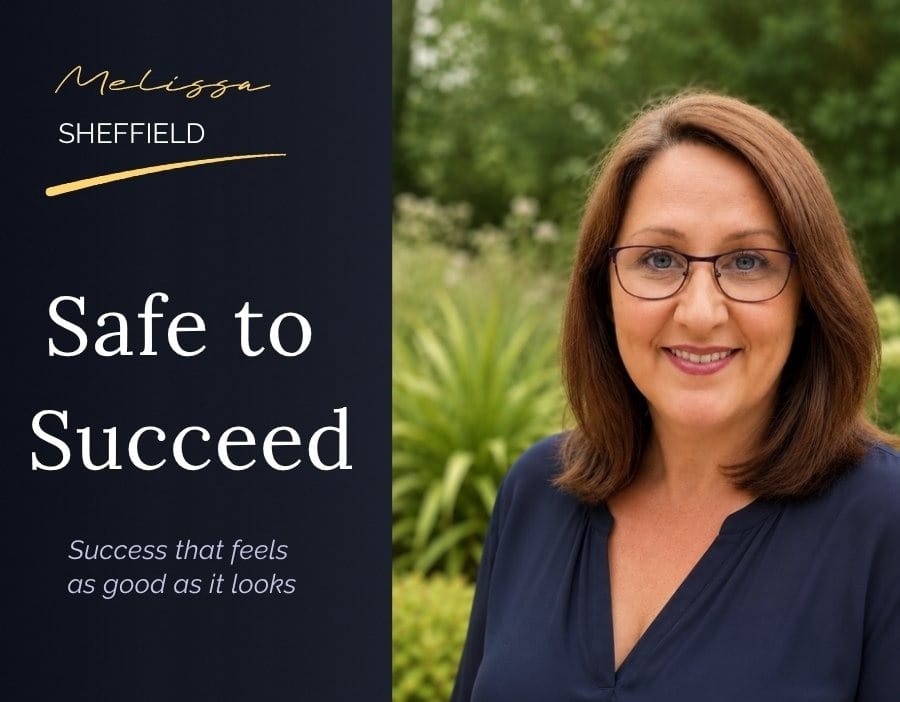
So I'm Mel, I'm a clinical hypnotherapist, and welcome to my Safe to Succeed podcast, episode two. I talk about all things subconscious and how successful, experienced women with lots of skills and knowledge can break through their subconscious ceilings to build their version of a successful business and life. Follow along and subscribe if that sounds like your sort of thing.
So today we are talking money. Okay. And here's the first thing I wanted to start with. Money amplifies what is already there. Wanting money does not make you a bad person. Wanting an abundance of resources to do exciting things with does not make you a bad person. And I understand a lot of people think like that. I grew up in a home where we had sayings like "the road to hell is paved with gold" and not a lot of spare money. So it feels like wanting money is a little bit taboo, a little bit out there, greedy, bad. And that's not true. Okay. Money is a neutral tool. It enables us to do more.
And if you are somebody who's not particularly pleasant and does unkind things to other people and treats them badly, yeah, your money's going to amplify that. But actually, if you're somebody who wants to support their family, who wants to use money to make memories, have adventures, do meaningful things that matter to you, the money is just going to amplify that. Money is not going to somehow install a new belief about you, it will just amplify what is there. So if underneath everything you know you're capable, you know your work is good, you know there's more where that came from, then more money makes you feel more of that. And it's lovely. And that will feel like it's a successful business and it was worth all the effort you've put into setting it up. And you can take that money and spend it on things you want.
But if underneath everything else you think that money is precarious, that it's there one minute and gone the next, that actually making more money and having more money makes you visible or found out, the money will show up more of that too, because the stakes just went up and you're worried that paycheck to paycheck just got harder because it's more variable. Okay, there's now more to lose. That's why you feel that way.
So the fact money amplifies what is already there is really important, because this is why, for a lot of women I've seen personally, it can be your best year in business, with your best paying clients, your best revenue, and you can be more anxious than you were in your worst year. And it's why women tell me they were happy earning less. I want to be clear, you weren't happier because you were earning less money. You were happier because it felt safer.
Okay, now here's the bit that takes a long time for a lot of people to understand. Your subconscious is not tracking your revenue. It has no interest in your revenue. Okay, none whatsoever. Numbers do not count to your subconscious. What it is tracking constantly, underneath absolutely everything else you're already juggling, is whether or not you're safe. And it decides whether or not you're safe using beliefs that it formed a long time ago. So it takes your past experiences, it takes your past beliefs, it takes past conversations, and it takes the outcomes of those things, and it judges using prediction what will be safe or not in the future. So if your beliefs about money are not positive, then your subconscious is going to see money as a threat. And when it tries to hold you back, to stop you wanting more money, to stop you making more money, it isn't actually being mean, certainly not being your friend, but it is trying to keep you safe.
Now, a part of the brain that I want to focus on today is called your reticular activating system, it's your RAS. You may have heard of it already, but basically it is your brain's filter, because the human brain receives sensory input constantly, and it's estimated to be around about one billion bits per second. Okay, but consciously, you only process, only notice, about ten bits per second. Because let's be honest, if your brain did not filter, you would go mad. You couldn't cope with that input. But what sets that filter is what you believe matters and what you believe is true, what you are training your brain to look for. So we are essentially looking at confirmation bias.
If you believe underneath everything that you are not good enough yet, that you're not ready yet, your attention, your RAS, it is filtering to keep you safe, which means it is filtering to reinforce your existing, your familiar thoughts. So when you say, "I'm not good enough, I'm not ready," it is actively searching for the evidence that that is true. So those ten bits per second that you are processing are going to be entirely focused on how you are not good enough. On the flip side, when you believe that you are ready, when you believe that you are good enough, your RAS is going to filter out all of the stuff, or certainly most of the stuff, that says you're not good enough. And it is going to focus on those bits of evidence that support your theory that you are good enough. Okay.
Think of it this way, Sliding Doors, one of my favourite films of all time. Think of it like a parallel universe. There are two identical months, the exact same revenue, the exact same clients, the exact three lovely emails, word for word saying how wonderful you are, and the exact same one difficult conversation. Now, in one of these worlds, that person is going to remember the email. That version of you has been trained to look for support of your theory that you are helping other people, that you are doing a good job, and that is going to be what you remember from the month. Now the other version of you, that version has been thinking about the difficult conversation since Tuesday, and you could barely remember what was in the emails. It's just some vague, "oh yeah, so-and-so sent a nice email." And here's the thing, if you said at the end of the month, "what was it like?" Version one will tell you about these lovely emails from clients. Version two of you will tell you about this awful conversation, and neither version is lying. Okay, it is just edited, no different than Sliding Doors.
We're not talking some future version of you who is a million miles away, like a lot of the internet does. This is still you, it is just how you have filtered this exact month. And this shows exactly why a good month can't fix that feeling, because the good month is going to go through the filter of "I don't feel good enough." Okay.
So what we need to do is train your RAS and your nervous system to believe that the version of success you are building is safe. Because here is the thing that doesn't get mentioned enough: people talk about your subconscious thoughts and your nervous system like they're not interlinked, and that is absolutely not true. My specialism is subconscious thoughts, but they are linked to your nervous system, because when you have a belief, your belief sets the filter, it sets your RAS to say this is what we're looking for confirmation of. That filter decides the information that you receive. It decides how you filter and perceive that. And then your nervous system will respond to the perception of what happened, not happened.
So think back to Sliding Doors. The exact same month, that edit will choose whether your nervous system is bracing and anxious because you're focusing on a really difficult conversation, or it will choose whether you are safe and ready to expand because you're focusing on those three wonderful emails. And here's a good thing about your nervous system and your subconscious thoughts being linked, they can work in this beautiful spiral. Now, obviously, when we spiral down and we've got negative subconscious thoughts, and we are then filtering the negative outcomes and our nervous system is bracing, that is not ideal, that is not what we're looking for. But when we flip that, when we teach our RAS to look for confirmation of our competence, of our success, of us feeling happy, when that is supported, the nervous system will relax. And that allows you to come back to clearer thinking and a wider view, and makes it easier for your RAS to notice those good things. So it's this beautiful positive spiral that we're aiming for. So although I focus on subconscious thoughts as a hypnotherapist, for those of you wondering how it is linked to your nervous system, it is linked in the most beautiful way.
So by now you should be getting the feeling that I'm a big believer, money is never really the goal. It is always about what do you believe that money will get you, what will it give you that you don't have now. So when somebody tells me they want to earn five grand a month, ten grand a month, one hundred thousand a year, whatever the number is, I'm always curious about the answer to the question, what will change when you have it? And there are lots of different answers, and none of them are right or wrong. It comes back to your version of success. You live in the life you want to live. And for some people that is the security of owning their own home in the town where they grew up, even though it's got really expensive. For other people, it's about the freedom to travel, about having choices and flexibility. A lot of the time it's literally finishing work at five o'clock and just saying, "I'm done," and not feeling guilty and not feeling stressed, but saying, "I know I've made enough that I don't have to hustle until the middle of the night." And that is actually the outcome. The money is just the vehicle that got you the outcome you want. It's just the direction of travel, it's your transport, okay?
The difficulty, though, is your subconscious can't actually experience a bank balance. And that sounds ridiculous, but your subconscious, it experiences emotions and imagery. It's why in hypnosis we use lots of guided imagery, because your subconscious will experience certainty or uncertainty. It will experience safety or threat. It will understand calm or pressure, but it's very binary. These are things that your mind is constantly moving towards, like safety, or moving away from, like danger. And often your mind will just direct that without you even knowing it's happening. And that's why two women can earn the same amount of money and experience it differently, because one person feels there are possibilities, there's security, there's more of what she values most, and the other person feels permanently behind because she hit the income goal, didn't feel any different, so just wrote a different number down to chase that instead. She's living in a loop of chasing something that she feels she should be chasing, but it doesn't give her any joy or satisfaction or alignment.
So maybe instead of asking "how much money do I want or need," we need to ask ourselves "how do I want my life to feel." And when you can actually answer that, not vaguely but properly in detail, that financial goal starts becoming much clearer, because you're not just chasing a number because somebody on Instagram said hitting six figures is amazing, you are chasing an outcome, and you know what number you need to get that outcome. The number just goes back to being the vehicle that gets you where you want to go. It's like just paying a taxi driver. And for me, getting clear on that has always been the most useful place to start.
And at this point, I get it, I've been talking a lot, so you might be thinking, fine, I understand this, so why do I keep going back to my old patterns, why do I keep just falling back in line. And it is a really fair question, and it happens with a lot of our habits and a lot of our thoughts, where the women I work with, they know their experience, they've got great client testimonials. They know deep down they don't need another qualification because they are qualified, and they still hesitate and overthink and doubt themselves, and a lot of them still feel a knot in their stomach when they send a proposal, or the day they actually launch this year's offer. And we need to understand that it's not because you're missing anything external, it's not you need another course, another strategy, another Facebook ad, it is internal.
Okay, it is your belief, and information and beliefs are not the same thing. You can understand something completely logically while the subconscious part of your mind continues behaving the opposite. So think about it like you're learning to drive. At first, when you get in the car, you have to really consciously think, "I must check my mirror, I must indicate in time, I must go from first to second to third, where is third?" Yeah, I was that learner driver. But with experience, you can actually drive without really thinking. It becomes natural instinct that you look in the mirror and indicate before you pull out into a quick lane on a motorway. And it becomes instinctive that you hear the engine rev and you change your gear. It just becomes a natural pattern of behaviour over time.
So beliefs work just like that. When they become familiar, they just happen. And eventually those beliefs will stop feeling like a belief and they start just feeling like reality. It is what it is, I am who I am, it's just there. And that's why, when you're trying to think your way out of these beliefs which you logically know are talking crap about you, but emotionally you still feel are true, you can produce all the evidence in the world that you're capable and successful and ready to achieve your version of success. But if your subconscious still associates this success with more pressure or more visibility or risk of judgement, that's the version of reality it's preparing you for.
It's not holding you back to be mean, like we said, it's holding you back to try to keep you safe. It's just being consistent with what it believes is true. And that consistency is where hypnotherapy can really help, because rather than spending months going around and around arguing with a belief that wasn't created logically in the first place, it was just picked up from different comments, conversations and behaviours, we just go directly to work with the part of the mind that formed it. And when we create enough repetition through emotional certainty, through new evidence, then your subconscious accepts a different version of what's true. And I want to be clear, it doesn't happen overnight, and it doesn't happen just through some toxic positivity by thinking the world is nothing but perfect. It works like going to the gym, you put the reps in, you see the result. Using that consistent change means your mind will eventually accept that it has a new normal.
And that's the reason my work isn't built around listening to a hypnosis track once and then just hoping you wake up feeling like everything in life is sorted. With all my paying clients, I use my Shift, Step, See framework, and I want you to try that this week for yourself. I'm going to tell you how to do it right now, for free, really easy.
Okay, so for shift, we are talking about shifting your subconscious thoughts. It all starts there, it makes everything else so much easier. So on my website, melissasheffield.com, there is a completely free, no catches, downloadable hypnosis track where you can get clear on your version of success. Try listening to it, not just once, but listen to it a few times, get clear, and then get clearer, and then get clearer again. What is it you are moving towards?
Next is the step, because you'll notice, after listening to the track a few times, after being able to visualise your version of success clearly, you're not going to change anything unless you make real world steps. Okay, your behaviour, your identity needs to reflect your understanding of success now. So pick a couple of small things, perhaps even one thing, one small step every day you can do that moves you closer to your version of success. It does not have to be big. It can be just sending that email without rewriting it five times to make sure it keeps everybody happy. It can be logging off at five o'clock and staying logged off, so you train your brain to know that actually the world won't burn down because you logged off. Whatever it is that gets you closer to your version of success, take a step every day.
And the last one is "see." And this is really important. I want you to get a pretty journal, and yes, it should be pretty, it should be something that brings you joy. Mine has Highland cows and sunflowers on it, because they bring me joy. And what I want you to do is write down, every day, the step you did. Sounds mad, but what we're doing is we're closing the cognitive loop. Okay, so you're going through the shift, shifting your subconscious thoughts, steps, putting it into action, embodying it, building your reality, and see, you are collecting a journal of all your successes, so that your brain has evidence that you are not talking about some future version of you a million miles away who is going to have the life you want. We are talking about you right now, that person. You're just waiting for the situation around you to change, and that is a very important distinction.
So these moments are going to make your new belief become stronger than the old one. And eventually that evidence, it just reaches a tipping point where the new way of thinking stops being unfamiliar, and that becomes your default setting. And that is the real goal. It's not just earning more money, it's about living that life that feels aligned and the life you actually want to live, and trusting that it is yours to keep, without it just disappearing overnight, because there is no logical reason that it should.
So that is your homework for this week, and I hope to speak to you again next week. Take care, and I'll see you then.


Quoted This Week

Topics Included this week
Why hitting your income goal doesn't always create the feeling of success you expected
How money amplifies existing subconscious beliefs rather than creating new ones
Why the subconscious tracks safety, not revenue, and how that shows up as your most anxious year being your best one
The Reticular Activating System (RAS) and how confirmation bias filters what you notice about your own success
The Shift, Step, See framework for turning subconscious insight into lasting change
YOU MIGHT ALSO LIKE
Large Call to Action Headline

M.S.
About Mel
I'm a clinical hypnotherapist and NLP Practitioner who specialises in subconscious shifts, identity moves, and success on your terms. I help women building successful businesses create subconscious safety around their own version of success, so they can build a business that supports the life they actually want to live.



Subconscious Safety and Success Tips in your Inbox!

Free Signup
Melissa Sheffield | Hypnotherapy
We use cookies to run this site and, with your permission, to understand how it's used. Essential cookies are always on. Read our Cookie Policy.